Almond Tea: A Romantic Script Handwritten Font for Branding
It started with a blank mood board and a client email: “We’re launching a small-batch herbal apothecary — think dried lavender, hand-poured tinctures, linen packaging, and quiet intention.” No flashy slogans. No tech-driven vibe. Just warmth, care, and gentle authenticity. I opened my fonts folder, scrolled past the overused scripts, and landed on Almond Tea. Right away, it felt like the first sip of something calming — soft, fluid, and unmistakably human.
Almond Tea for Apothecary Branding and Herbal Product Labels
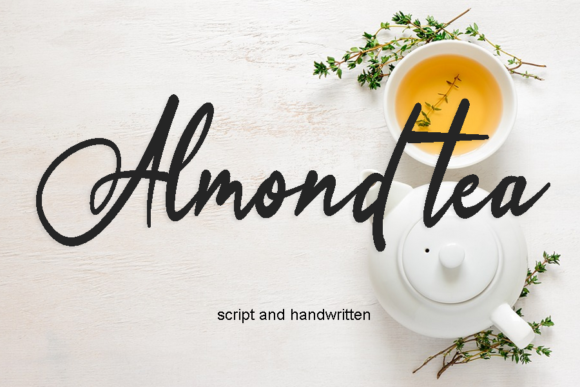
Almond Tea is an enchanting handwritten font — not stiff or overly ornate, but full of subtle rhythm and organic flow. As a Script Handwritten typeface, its lowercase ‘a’ has that delicate upward flick, the ‘g’ curls just enough to feel intentional, and the spacing breathes like handwritten notes left on a kitchen counter. For the apothecary’s product labels, I tested Almond Tea at 18pt on matte kraft sticker stock — and it held up beautifully. Not too thin, not too heavy. It read clearly at arm’s length but still carried that romantic, artisanal whisper the brand needed. Unlike some delicate script fonts, Almond Tea doesn’t vanish in print — it stays legible without sacrificing personality.
Almond Tea in Logo Design and Business Card Typography
I drafted three logo concepts using Almond Tea as the primary wordmark. One version used only the font, centered, with minimal tracking — clean, confident, quietly elegant. Another paired it with a light serif (think Garamond Light) for the tagline: “Botanicals, thoughtfully gathered.” That pairing worked because Almond Tea carries all the expressive weight, while the serif grounds it with structure and readability. On business cards, Almond Tea shines at 24–32pt for names and titles — large enough to feel personal, small enough to avoid overwhelming the layout. As a Fonts asset, it’s designed for display use, not body text — and that’s exactly where it excels: logos, monograms, shop signs, and engraved wood tags.
How Almond Tea Performs in Social Media Graphics and Instagram Story Headers
For Instagram posts and story banners, I dropped Almond Tea into Canva and Figma — no rendering issues, smooth kerning, and consistent glyph behavior across platforms. Used at 48–60pt on soft beige or sage backgrounds, it instantly elevated seasonal announcements (“Spring Tonic Drops Arriving Friday”) and event invites (“Herbal Workshop — May 12”). Because Almond Tea is a Script Handwritten font with natural variation in stroke weight, it avoids the flat, AI-generated look that plagues so many modern scripts. It feels drawn, not generated — and that difference reads emotionally, even in a 3-second scroll.
Almond Tea for Greeting Cards and Editorial Design in Small-Batch Publishing
The client also wanted limited-edition greeting cards — botanical illustrations with short, poetic copy. Here, Almond Tea became the heartbeat of the layout. I used it for headlines and salutations (“Dear Friend,” “With Warmth,” “A Note from Our Garden”), then switched to a warm sans serif (like Poppins Light) for body text. That contrast kept hierarchy clear while preserving the romantic feel Almond Tea delivers. As a Fonts choice for editorial design, it works best in short bursts — not paragraphs, but moments of emphasis. Its versatility lies in how gracefully it transitions from digital mockups to letterpress proofs or foil-stamped envelopes.
Almond Tea for Wedding Invitations and Elegant Branding
Even though this wasn’t a wedding project, I couldn’t resist testing Almond Tea in that context — because its romantic tone is undeniable. On ivory cotton paper with muted gold foil, Almond Tea looked effortlessly refined. No extra flourishes needed. The Script Handwritten quality gave it intimacy; the even baseline and open counters kept it accessible. For designers building wedding stationery suites, Almond Tea pairs beautifully with classic serifs (Baskerville, Mrs Eaves) or airy sans serifs (Lora, Canela). And yes — it includes standard ligatures and stylistic alternates, which matter when you’re fine-tuning “The” or “And” in a couple’s name.
Testing Almond Tea Across File Formats and Commercial Use Cases
I always check licensing before committing — especially for client work. Almond Tea is a commercial Fonts license, meaning it’s cleared for use in client branding, merchandise, web headers (via @font-face), and printed marketing materials. It comes in OTF and WOFF2, with full Latin character support — perfect for English-first brands with occasional French or Spanish phrases (think “tisane,” “bienvenue”). No multilingual expansion, but it doesn’t need one: its strength is focused, emotional impact — not global utility.
Almond Tea as a Display Font for Packaging Design and Shop Signage
On the apothecary’s glass jar labels, Almond Tea sat above minimalist line art — and it didn’t compete. It complemented. As a display font, it commands attention without shouting. At 36pt on curved ceramic jars, it flowed with the shape instead of fighting it. For shop signage, I mocked it up in white vinyl on reclaimed wood — again, the romantic feel came through, but so did clarity and craft. That balance is rare. Many Script Handwritten fonts sacrifice legibility for flair; Almond Tea keeps both.
If you’re choosing a Fonts asset for a brand that values sincerity over slickness — whether it’s a candle studio, a ceramicist’s online shop, a slow-fashion label, or a neighborhood tea house — Almond Tea isn’t just another script. It’s a quiet collaborator. It doesn’t dominate the design — it deepens it. And when your client sees their name in Almond Tea for the first time, they don’t just say “I like it.” They pause. Smile. Say, “That feels like us.” That’s the power of the right Script Handwritten font — and why Almond Tea has earned a permanent spot in my go-to folder.